
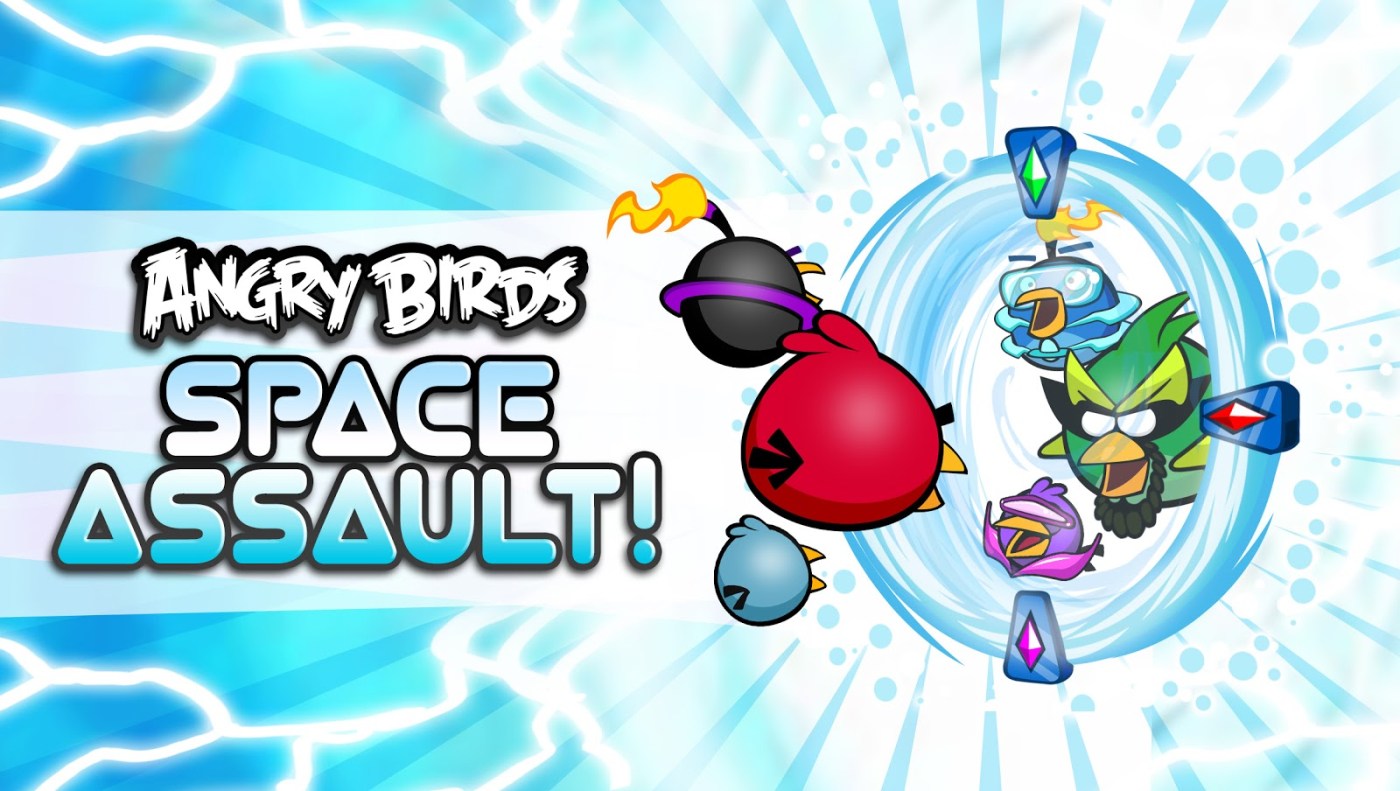
Angry Birds: Space Assault was a single/multi-player adventure/puzzle/collectible card game intended for all platforms. It intended to take the tried and true slingshot action and crazy bird effects of its namesake into 3D and mix it with collection and base-building, strategy, and robust multiplayer. The design was compelling, but unfortunately never became a shipped product. However, the studio took it seriously enough that we produced a fair amount of work in order to prove out the concept.
That’s what I’m going to show you here—and remember, I did all of this about a decade ago, so judge it kindly.
This is the story of the conception of Angry Birds: Space Assault.
Rovio and KLab
While I was still at KLab America, our dev team had an opportunity to figure out what came next after Crystal Casters and Glee Forever. The corporate office let us know that an opportunity presented itself: Rovio was interested in working with KLab to make an Angry Birds game—specifically, they offered Angry Birds Space.

I was intrigued. Angry Birds was a monster property, even before the movies came out. It had a huge following and the potential to leverage it to make a hit was real. Even so, KLab wasn’t the only one they approached about making Angry Birds games. In fact, in its heyday, Rovio released a bunch of them in almost every genre.

Even though Rovio’s enthusiasm for propagating their flagship property diluted its value a bit, I was still excited to be a part of the Angry Birds family. I dove into the prospect.
3D or not 3D
In speaking about possible designs for the Angry Birds mechanic, I still remember someone’s comment at the office. A staff designer said, “Why don’t you just take it into 3D?”
As simple as that sounded, the idea stuck with me. It wasn’t as straightforward as just throwing 3D birds at 3D obstacles, but the idea that perspective could be a factor was intriguing. Maybe if you couldn’t attack a building from the front because the defenses were too strong, you could move around the side and potentially spy a weakness.
So, our milieu was space, but I didn’t like a rocket ship flying anywhere the player wanted to go. I wanted tighter constraints than that. I wanted to design puzzles based on places I knew the player could go. In this way, I constructed the first navigation map.

Movement was intentionally easy to both understand and use. The player flew from navigation point to navigation point.by tapping on either those points or the paths between them. There was no slowing or stopping between points. In this way, I could construct exactly what I wanted the player to interact with, the challenges they had to face, and when they’d face them. This was right up my alley: combining adventure game design with FPS level design.
Once I’d fleshed out this concept, I realized that seeing it in action would be WAY more powerful than just listening to me describe it. I worked with artists and animators Weston Tracy and Brad Fitzpatrick, as well as sound designer Dren McDonald, to construct a full animated movie of what the gameplay might be like.
And here it is.
Now, I posted this movie here on my page some years ago, but never intended to release it until I wrote this article to explain it—which I didn’t. For years. Nevertheless, someone discovered the movie and distributed the link to the world. In fact, one of the most reliable sources of traffic to this site has been from AB fans coming to see this video. Now I’m happy that everyone will get a bit more context to understand the gameplay.
The video shows a number of intended features:
- Travel along the nav points
- Using nav points to get another perspective on a target
- Carrying a limited set of birds as crew in a ship
- Choosing from those birds to address the challenge
- Puzzles like destroyable force fields or asteroids that revealed additional paths
- Traps like the armed space stations
- Nav map to see where you need to go to collect the eggs
- New targeting method
The last feature, the targeting method, was actually quite important. The intended target was fixed and obvious. The player could decide on the bird choice, the velocity, and when to activate the bird’s ability, but he would always hit his target. This was intended to make the game more strategic and less skill based. The player’s collection of birds and how they used them against the obstacles was the real game, not launching birds and praying for the best.
My Trip to Finland
After multiple on-line presentations, Rovio invited us to their corporate headquarters in Finland. This visit was incredible. My overseas trips were mostly limited to Italy and I found this place to be unique and beautiful—and obsessed with saunas. Seriously! If these Finlanders could have done all their business in saunas, I think they would have. And is that really such a bad thing?


After the Rovio execs took their turns to show off their incredible headquarters (and their network and dev ecosystem), it was my turn to present my concept. As nervous as I was, the meeting couldn’t have gone better. While I started with the movie to grab their attention, I then launched into the full up deck to describe the design, including progression, multiplayer, and monetization. The presentation walked them through everything I intended.
They were blown away. Later, one of them told me that as soon as they saw the design map, they knew they were in good hands. Dinners afterward were full of laughter and excitement. I left that trip thinking the future was assured.
For the first time, I’m making this presentation available here (it’s so big, I had to put it in as a slideshow. Just click your way through the slides).
You can see everything, from the fictional universe to the base building to the crazy multiplayer (which I was really excited about). I won’t walk through all these features, but they represented most of my thinking about this game and my passion for it all was clear.


After we left, Rovio let us know that they were solidly on board. They wanted this game and they wanted us to build it. But there was one big obstacle to making that happen: KLab Japan.
Our KLab Overlords
Angry Birds just wasn’t as big of a property in Japan. They knew about it, but didn’t value it quite as much as we did in the west. They were interested in this game, but far from convinced that it was a viable venture—especially because of the licensing agreement with Rovio (which meant it had to be quite successful to earn out, when many of the Angry Birds games were not).
Up against a skeptical audience in Japan, I asked to put together a prototype to really demonstrate if playing AB in 3D could be fun. They agreed, but suggested their dev studio in the Philippines to build it. This studio was known as the place they turfed low-performing games to get the last bit of revenue out of them before sunset. It was clear that the Japanese devs didn’t hold them in high regard. But they had one thing going for them: they were inexpensive.
Not knowing what to expect—but with few other options—I signed up to work with a Philippino dev team, hoping I could leverage my own ability to coax great work out of the people I’m making products with (which is what my career was mostly based on).
At first, development was rocky. It become clear that the Philippine devs had their own approach. There was definitely talent there, but it was hard to manage from afar. So in order to get the project on track, I was offered the chance to go there myself.
Again, I’m not a world traveler, so I had no idea what to expect. I wasn’t excited, but this was the only way forward. I chatted with Weston (the animator who put most of the initial movie together) and tried to convince him into joining me for a few weeks as a level designer. He was less of a traveler than me and NOT excited to go. In fact, the day we were supposed to leave, a monsoon attacked our destination and we could not raise anyone there on the phone.
Weston refused to get on a plane until we could confirm it would be safe. The next day, they told us they were safe—this kind of storm happened all the time, and they were just out of the office—and so we took a later flight.
Coming to Life
I was far more impressed with the KLab studio there than I ever expected. The facilities, located in the high-end area of the city, were top-notch. I could even walk from their building to a swanky mall—which was awesome if you just ignored all the armed guards everywhere, one of the reasons the area was so peaceful and safe.


Weston and I met the developers we’d worked with from afar. They were earnest and enthusiastic. They wanted very badly for this game to succeed, especially if it meant raising the profile for their team. Getting recognition from the home base in Japan was not easy (or likely), but they would work as hard as they could to achieve it.
For a few weeks, I lived there and produced a working prototype. Given our time and budget constraints, we had to make some sacrifices, but even so, I’m proud of what we produced. The only intention was to show the promise of the game, not a finished product, and we did that. It was a great first step and I’m proud of the team that made that possible.
Here is a movie of the prototype we delivered.
One of Japan’s concerns was the aiming mechanic we were using. Even though Rovio was completely on board with the strategic decision making part of the design, some of the brass in Japan weren’t convinced—so you’ll notice we included some additional aiming schemes at the end, just in case.
The Verdict
We went through multiple reviews with Japan. Many were astounded that the team in the Philippines were able to create it. There was clearly fun there, but it all came down to one single review session. They asked for me to attend in person (I’d been to the Japan offices once before), but given that I do not speak Japanese, I decided to join remotely and let a production assistant from our office who did speak Japanese attend in my place.
That might have been a mistake.
Given that I don’t speak the language, I don’t know exactly what was said, but I have to admit that I became concerned when my PA began to answer design questions directly without involving me.
And they said no. We would not be moving forward to make this game.
Perhaps my not being there affected the outcome, but it’s impossible to know. At this point I regret not attending, despite the language barrier. I know my passion is one of the most powerful weapons in my arsenal, and I was not able to leverage it.
Angry Birds: Chain Reaction?
So, Angry Birds: Space Assault was dead. And while Glee: Forever wound down, it became clear that the experiment that was KLab America wasn’t long for this world.
Even so, I so loved the idea of doing an Angry Birds game that I came up with another concept and I decided to pitch it as well (although not at KLab). I envisioned that Rovio might work with Jam City (a local developer of mobile puzzle games) to make it, with me heading up design.
It’s not worth its own article, but here is the deck that Brad Fitzpatrick and I put together to pitch that game. Despite Rovio’s interest in both titles, without a dev studio behind us, it didn’t come to light either.
Here is the deck that describes Angry Birds: Chain Reaction, a quite squishy puzzle game that would have been a hell of a lot of fun!


My experience in the Angry Birds universe was ultimately not fruitful and a bit disappointing, but quite fun nonetheless. I hope you enjoy these glimpses into my experience and can envision what these games could have been.
And if you made it here looking purely for Angry Birds material, do me a favor and check out something that DID ship: my award-winning fantasy series: the Chronicles of Chaos.
If you like twisty plots, engaging characters, and a unique world, you’ll love my books!


 The Mysterium